


New Online Listening Experience Invites Public Into the Underwater World of Dolphins
The newly launched Sarasota Bay Listening Network (SBLN) website connects the public with the sounds of the bay and a long-term resident bottlenose dolphin community
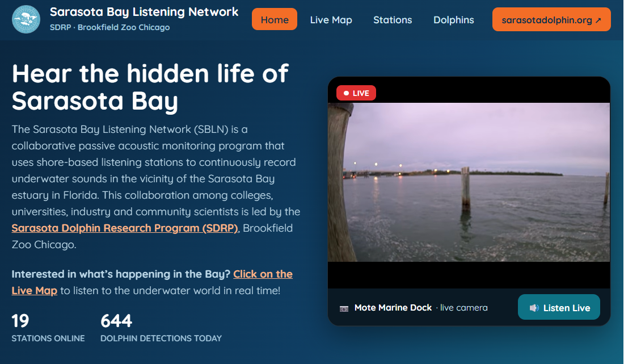
What does Sarasota Bay sound like beneath the surface? A new interactive website from Brookfield Zoo Chicago’s Sarasota Dolphin Research Program (SDRP), developed by Loggerhead Instruments Inc., gives anyone, anywhere, the opportunity to listen beneath the surface and get to know the marine life of the bay in a new way — through sound, the same sense dolphins rely on to navigate their environment and connect with the world around them.
The website brings the Sarasota Bay Listening Network (SBLN) to the public. Led by SDRP, SBLN is a collaborative passive acoustic monitoring program that uses hydrophones (underwater microphones) at 20 shore-based listening stations to continuously record underwater sounds in and around the Sarasota Bay estuary. The network has collected more than 500,000 hours of acoustic recordings since 2017, capturing sounds of bottlenose dolphins, manatees, fish and invertebrates, along with vessel traffic, weather and other features of the bay soundscape.
Visitors can click through a map of the bay, listen live to underwater audio and get to know individual dolphins. The website features profiles for more than 100 individuals that can be acoustically identified by the SBLN in near-real time via their individually-specific signature whistle “names.” The profiles include recent acoustic detections that can be viewed and listened to, photos, fun facts, links to relatives’ profiles and a map 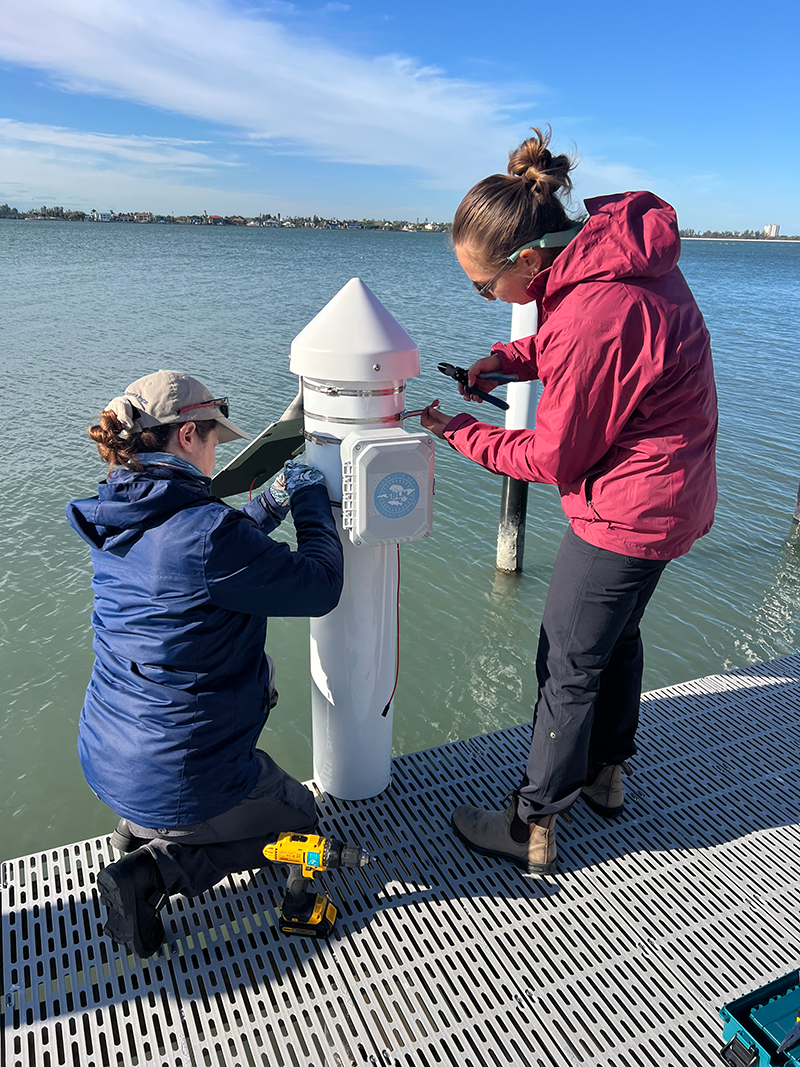 showing where individuals have recently been detected. Drawing on decades of SDRP research, the new SBLN website opens a more personal window into marine life.
SBLN is one of two underwater acoustic monitoring networks that form the Sarasota Passive Acoustic Listening Stations (PALS) Network. Its sister acoustic network, the Sarasota Coast Acoustic Network (SCAN), listens for acoustically tagged sharks, rays, fish and gastropods. Together, SBLN and SCAN provide valuable information about animal ranging patterns, habitat use and behavior, as well as insights into the health of the broader ecosystem. Visitors to the SBLN website can see summaries of SCAN species detections at 14 SBLN stations where SCAN acoustic receivers are also deployed.
“Sarasota Bay is a thriving ecosystem, and listening to its soundscapes allows us to follow wildlife over time and understand how animals respond to red tides, vessel traffic and other changes,” said Dr. Katie McHugh, director of SDRP. “Those insights help guide conservation decisions. By sharing these sounds online, we are giving people a new way to experience the bay and connect with its wildlife.”
The individual dolphin experience is made possible by more than 56 years of collaborative research on Sarasota Bay’s resident bottlenose dolphin community and a long-term archive of signature-whistle recordings called the Sarasota Dolphin Whistle Database (SDWD). The SDWD is a unique resource managed by long-time SDRP collaborators at Woods Hole Oceanographic Institution (USA), Aarhus University (Denmark), University of St Andrews (Scotland) and Cetacean Communication Research (USA).
“Sound is central to how dolphins experience the world. They whistle, click and buzz as they navigate, communicate and hunt. Each dolphin develops a signature whistle as a calf and keeps it throughout life, creating an individually learned call that functions much like a name,” explained McHugh. “By matching those whistles to validated recordings collected through decades of SDRP research, we can identify individual dolphins and learn more about how they use Sarasota Bay.”
SBLN offers a level of individual dolphin identification not available through other passive acoustic monitoring platforms. A machine-learning tool identifies possible signature whistle matches by comparing with known signature whistles from the SDWD. Researchers continue to review and refine the system as more data becomes available, supporting broader efforts to automate individual dolphin identification while maintaining human review of the detections.
Future website updates are expected to expand the number of individual dolphins represented and add more ways to interpret the bay’s broader soundscape, including noise from vessel traffic. As the network’s capabilities grow, the website will offer an even deeper dive into the marine life of Sarasota Bay.
- Explore the SBLN website now
- Learn more about SBLN and SCAN here