



Thanksgiving Dinner with… Dolphins?
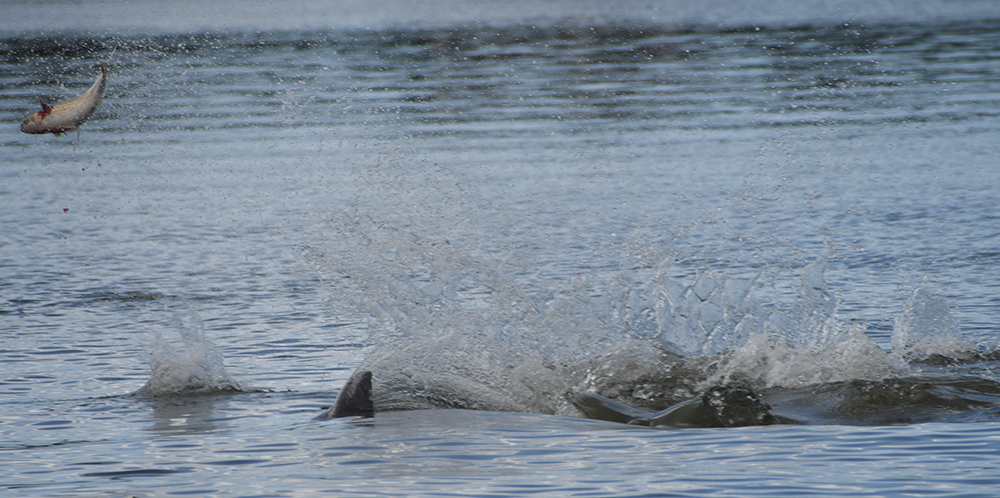
Many of us (in the U.S.) are probably getting ready for our 2026 Thanksgiving meal right about now. We might be setting the table with the good dishes, putting on our favorite tunes and prepping for the meal. We probably also invited some of our family and friends to the table. Which got us wondering, what would your dinner be like if you were hanging out with the dolphins?
- Throwing your food would be acceptable and even encouraged! Sarasota dolphins sometimes use their tail flukes to strike fish, launching them into the air before making quick work of them.
- Chewing — with mouth open or closed — would be frowned upon. Dolphins typically position fish headfirst and swallow them whole — no carving necessary!
- Dinner with a splash! Some Sarasota dolphins use a technique called kerplunking to catch dinner. That’s when they forcefully slap their tail flukes into the water to create bubbles and splashes that flush prey from hiding.
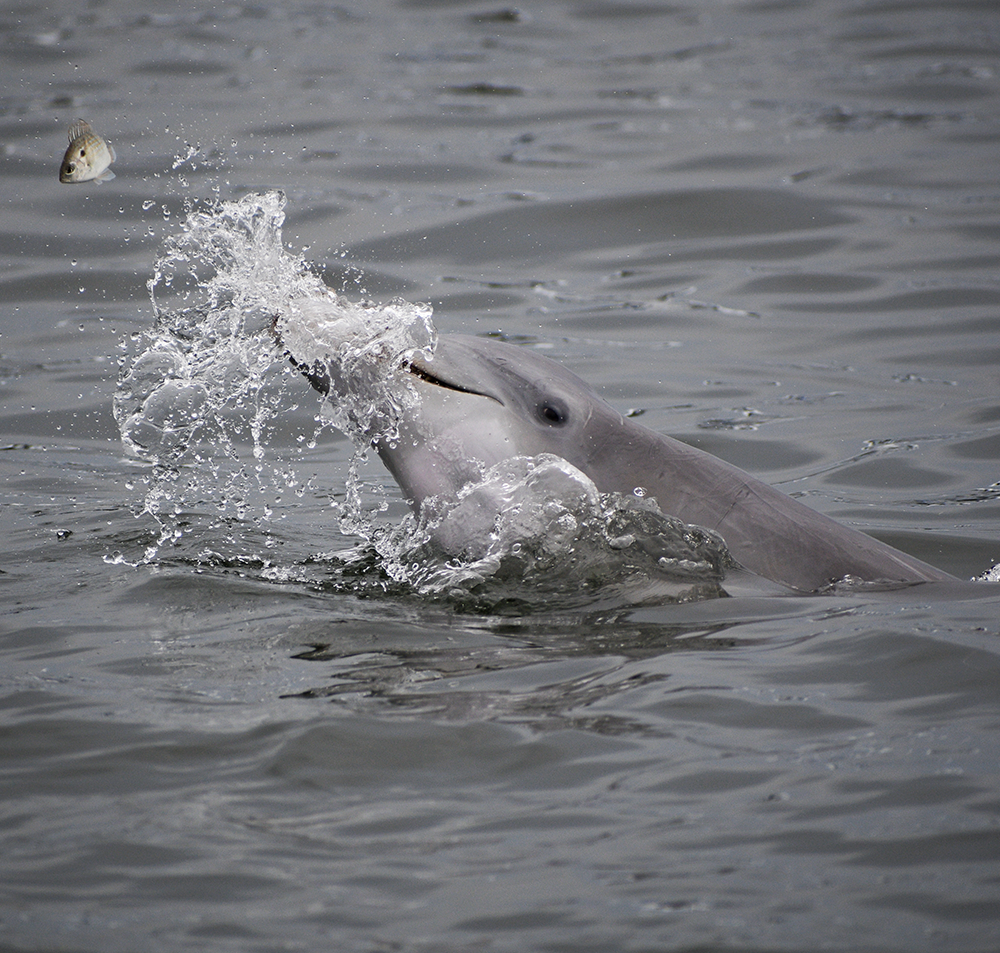
- Forget big gatherings of friends and family. Dolphins in Sarasota often forage alone or in small groups, capturing just one fish at a time.
- It’s not about what smells good; but what sounds good. Dolphins don’t have the typical olfactory structures needed to sniff out dinner. Instead, they listen for fishy sounds: Pigfish, for instance, grind their teeth. Other species — like Gulf toadfish— make sounds by vibrating their swim bladders.
What’s on the Menu?
The Top 10 prey fish of Sarasota Bay dolphins are:
- Pinfish
- Pigfish
- Scaled sardine
- Atlantic threadfin herring
- Ladyfish
- Mullet
- Sheepshead
- Spot
- Spotted seatrout
- Gulf toadfish
-
Want to hear what a Gulf toadfish sounds like? Click here!
Fishwhacking
Did you know that dolphins have developed a variety of feeding techniques that they pass down from generation to generation? One of the most acrobatic that we see in the Sarasota Bay dolphin community is fishwhacking, which we first documented in the 1980s.
-
Click here to check out more videos on dolphin feeding techniques
Further Reading
- Wells, R. S. (2019). Common bottlenose dolphin foraging: Behavioral solutions that incorporate habitat features and social associates. Pp. 331-344 In: B. Würsig, ed., Ethology and Behavioral Ecology of Odontocetes, Ethology and Behavioral Ecology of Marine Mammals. Springer Nature Switzerland. https://doi.org/10.1007/978-3-030-16663-2_15
- Wells, R.S., et al. (2013). Evaluation of Potential Protective Factors Against Metabolic Syndrome in Bottlenose Dolphins: Feeding and Activity Patterns of Dolphins in Sarasota Bay, Florida. Frontiers in Endocrinology, 4:139. https://pmc.ncbi.nlm.nih.gov/articles/PMC3794307/
Barros, N.B. & Wells, R.S. (1998). Prey and Feeding Patterns of Resident Bottlenose Dolphins in Sarasota Bay, Florida. Journal of Mammalogy, 79(3), 1045–1059. https://doi.org/10.2307/1383114 - Gannon, D.P., et al. (2005). Prey Detection by Bottlenose Dolphins, Tursiops truncatus: An Experimental Test of the Passive Listening Hypothesis. Animal Behaviour, 69(3), 709–720. https://doi.org/10.1016/j.anbehav.2004.06.020
- Berens McCabe, E.J., et al. (2021). Effects of Multiple Karenia brevis Red Tide Blooms on a Common Bottlenose Dolphin (Tursiops truncatus) Prey Fish Assemblage: Patterns of Resistance and Resilience in Sarasota Bay, Florida. Frontiers in Marine Science, 8:711114. https://doi.org/10.3389/fmars.2021.711114
- Kremers, D., et al. (2016). Sensory Perception in Cetaceans: Part I—Current Knowledge about Dolphin Senses as a Representative Species. Frontiers in Ecology and Evolution, 4:49. https://doi.org/10.3389/fevo.2016.00049
- Sarasota Dolphin Research Program. Fun Facts. https://sarasotadolphin.org/fun-facts/