


The Little Dipper: Drone-based Eye in the Sky, Ear in the Sea
Since 1975, Sarasota Bay has been used extensively for testing electronic tags, including radio-tags and satellite-linked tags, for tracking the movements and behavior of dolphins, leading to the very small transmitters used widely today. Today, we continue to advance development of new tools and methods that can help us better understand dolphins, their movements and even their behavior. We developed, tested and deployed the TADpole, a pole-mounted tag attachment device (read more here). Another tool we are working to develop is the Little Dipper, a drone-based eye in the sky and ear in the sea.
Given the importance of acoustics to cetaceans, it’s highly desirable to be able to add an underwater soundtrack to the visual behavioral observations we record from a drone. To date, this has been accomplished through the deployment of hydrophones from boats or shore at some distance from the focal animals, followed by post-processing to synchronize the video and acoustic recordings.
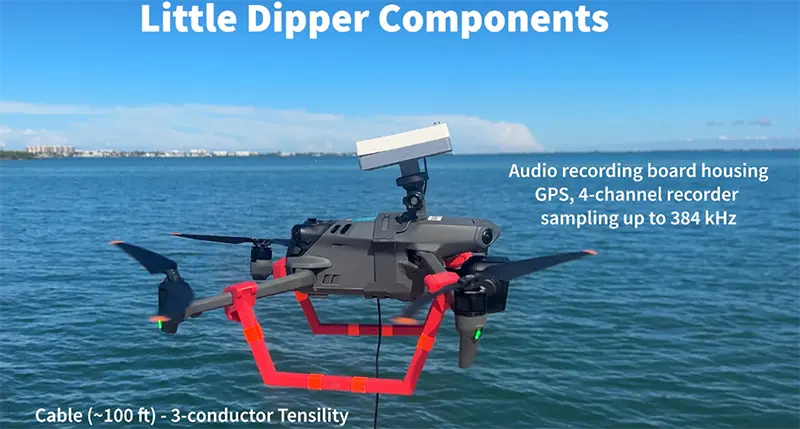
More recently, we have developed a drone-mounted acoustic recording system that can obtain synchronized recordings from the position of the drone.
A DJI Mavic 3 Pro drone is equipped with a custom recorder. The 4-channel recorder can sample up to 384 kHz and includes a GPS receiver for precise timing and location, including the option to record the pulse per second signal with nanosecond accuracy. A 22g HTI-96-min hydrophone (-170 dBV/uPa) is suspended at the end of 36 m of 3-conductor Tensility lightweight cable.
The drone lifts the cable and hydrophone into the air and travels to the desired observation site, where the hydrophone is dipped into the water to a depth of 1 m. When repositioning is desired, the drone lifts the hydrophone from the water, and moves to the new location, where it is dipped again.
During field tests, while the initial dipping appears to have been noticed on occasion, normal activities continued thereafter, and we have been able to obtain high quality video and audio recordings. The extra weight of the recorder, hydrophone, and cable results in a slight decrease in flight duration.
The Little Dipper shows promise for being able to obtain better quality concurrent acoustic and video recordings closer to the animals than may be possible or desirable from a boat or shore. The system can also serve as a second hydrophone, with a GPS location from the drone, to facilitate sound localization in combination with boat/shore-based hydrophones.
- You can learn more about the Little Dipper here from our partners on the development of this tool, Loggerhead Instruments.