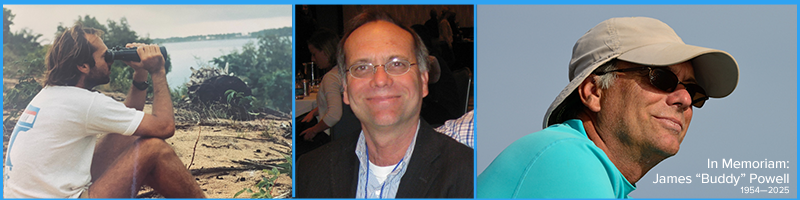
Celebrating the Life of Dr. James “Buddy” Powell

Please join us for a celebration of life for Dr. James “Buddy” Powell, a pioneering conservation scientist who spent more than 50 years working to save manatees and other endangered species around the world. Buddy, a recipient of the prestigious Pew Award in Marine Conservation in 2000, was Chief Zoological Officer of Clearwater Marine Aquarium, and Executive Director of Clearwater Marine Aquarium Research Institute (CMARI) when he died following a brief illness. His integrated approach to developing solutions to conservation issues led to the protection of coastal areas in Florida, West Africa, Belize and Cuba.

  • Colleagues, friends and family will celebrate Buddy’s extraordinary life from 4:30 to 7:30 p.m. Sunday, Nov. 16, 2025, at the Clearwater Marine Aquarium, 249 Windward Passage, Clearwater, FL 33767. Please click the link to RSVP.
  • Response requested by Nov. 10, 2025
  • Please use the form below to share a memory of Buddy with his friends and family.
  • If you have additional photos of Buddy, please consider uploading them here. They may be included in the Celebration of Life, but even if they are not, they will be cherished by Buddy’s family.

Share Your Memory

Do you have a memory or a story about Buddy that you would like to share? Please share it below.

Memorial Tribute Submission

Maximum file size: 52.43MB

Pat Rose

Buddy's Profound Legacy

November 16, 2025 · by Pat Rose

Pat Rose

While I did not begin to work with Buddy until 1976, we unknowingly crossed paths multiple times in Kings Bay/Crystal River as far back as the later 1960's. It was my honor to feature Buddy's unmatched tagging and tracking work with manatees in the '70's in Crystal River in my documentary narrated by Lenard Nimoy: Silent Sirens: Manatees in Peril. I am so grateful for the many opportunities we have had to share our lengthy manatee journy as friends and allies. Together with the USFWS and the City of Crystal River we are working to further celebrate Buddy's and Woodie Hartmen's seminole contributions to the knowledge and protection of Florida manatees, so it can be seen by all those who visit 3 Sisters Springs.

- Pat Rose, Colleague, Cohort and Collaborator for half Century+

Kristen Mazzarella

November 16, 2025 · by Kristen Mazzarella

Kristen Mazzarella

Buddy was an excellent mentor. He always tried to set people up to succeed by connecting them and supporting them in research endeavors and goals. I will never forget when I was able to accompany him to Cuba for a MARCUBA meeting where I was able to meet Cuban sea turtle researchers and expand my education of all things Gulf of Mexico as well as learn about the amazing wildlife and culture of Cuba. Buddy’s support has stayed with me and taught me how to be a good mentor to the volunteers and interns I have overseen over the years.

- Kristen Mazzarella

Damien Leloup

November 15, 2025 · by Damien Leloup

Damien Leloup

A couple of winters ago, Buddy and I were walking along the Crystal River waterways, when he was telling me how over the years he had learned to recognize and personally know many manatees--some of them for decades. Twenty minutes into our walk, a manatee breath broke the surface only ten feet away from us, and stared at us for a moment. Buddy immediately recognized her and called her by the name they had given her. He had known her as a calf over thirty years ago... he knew her mother, and most of the other calves that came after her. This is one of many examples of how deeply connected he was to the animals he admired so much. The world has lost a precious and rare individual, and the manatees have lost their most passionate advocate. You will be missed by all Buddy, but your work and passion will go on.

- Damien Leloup, Friend, colleague; we both started with Jacques Cousteau as our first job, and at the same age.

Bill Smith

November 15, 2025 · by Kathy Perrott

I miss Buddy dearly! He contributed so much to this world in so many ways and in so many places but I will always remember him best for his kindness and warmth as a human being. His legacy looms large and will be continued by the many people he inspired to pursue scientific research and marine conservation efforts.

- Kathy Perrott, Clearwater Marine Aquarium Board of Directors

Bill Smith

November 13, 2025 · by Gretchen Lovewell

In every interaction with Buddy, his kindness and helpfulness stood out. He had a quiet strength and a genuine care for footed and finned alike that left a lasting impression. Buddy’s mark will continue to be felt by the animals and people lucky enough to know or be affected by him.

- Gretchen Lovewell

Patrick Berry

November 13, 2025 · by Patrick Berry

Patrick Berry

Buddy was always so kind, so knowledgeable, and always in that researcher frame of mind – always thinking, learning, and teaching. What a cherished gem we had in Buddy.

- Patrick Berry, Gulfarium

Jacob Tindall

Inspired

November 11, 2025 · by Jacob Tindall

Jacob Tindall

It was an inspiration to see how Buddy was able to contribute at such a young age. I appreciate so much how he let me ask questions after Jamal's manatee presentation last year.

- Jacob Tindall, CMA

Bill Smith

November 10, 2025 · by Nelson and Jo Cruz

Buddy will be remembered for his extraordinary accomplishments in the fields of research and conservation, but we also remember Buddy as a kind, dedicated man who treated everyone like they mattered.

Regardless of who you were or how large or small a role you played, he made you feel valued.

He was always accessible to listen, to answer questions, to mentor, to teach, and to guide. He exemplified what a leader should be.

One evening, we were bringing a rescued sea turtle into the surgical suite after hours, and Buddy was bringing a group of board members around. We did what we needed to do for the sea turtle and were ready to leave. We didn't want to interrupt, so we waited until they moved further away and tried to exit quietly in the other direction. Buddy wasn't having it. He introduced us to the group, saying "how wonderful and dedicated our volunteers are." While we were surprised and a little embarrassed, we were also proud to be acknowledged by him.
That was Buddy.

The Right Whale Festival this year was dedicated to his memory. It wasn't the same without him, but we shared Buddy stories and laughed about the previous year.

Every year at the festival, we have life-sized inflatable whales, so maybe 50 feet long. At the end of the festival, we have to deflate the whales, and in an attempt to get the remaining air out faster, we all pile onto the whales and roll around on them, and Buddy joined right in.
That was Buddy, too.

We miss him.

- Nelson and Jo Cruz, Clearwater Marine Aquarium Volunteers

Suse Shane

November 6, 2025 · by Suse Shane

Suse Shane

- Suse Shane

Bill Smith

October 30, 2025 · by Noel Takeuchi

Buddy (and Maureen) always supporting everyone who crossed his path, in and out, of the field. Thank you for being there for us, Buddy!

- Noel Takeuchi, University of Florida, University of South Florida

Nadine Slimak

Buddy Powell: A Life on the Edge of the Sea

October 28, 2025 · by Nadine Slimak

Nadine Slimak

In 2005, when James “Buddy” Powell was Director of Aquatic Conservation for Wildlife Trust, SDRP colleague Nadine Slimak had the opportunity to interview him for a feature story. We think the anecdotes and highlights Buddy shared captured his spirit as a conservation biologist and a friend. With news of his passing in July 2025, we thought we would share his story with you. — SDRP

Long before Florida became one of the nation’s most visited states, before snorkelers and divers descended en masse on the tiny town of Crystal River to swim with the manatees, Dr. James A. “Buddy” Powell decided to give it a shot.

Powell, first introduced to manatees while fishing with his dad on the river when he was 5 or 6 years old, was always curious about the lolling mammals – and rather wary of them. “No one really knew anything about them back then, but I was always sort of curious,” says Powell, who at 51, now recounts the story of himself as a teenaged kid sitting on the edge of a boat, screwing up his courage to get in the water near a manatee. For a man whose life work has since been focused on manatees and their cousins the dugongs, you’d think the experience would have been some sort of epiphany.

Wrong.

“It was a frightening experience for both of us,” he says. One look at Powell, and the manatee spurted away in a splash and great spray of water. “I was terrified. I jumped in the water and then jumped right back out.” While it might not have been the most auspicious start to a career as a conservation biologist for a man who now heads up the Edge of the Sea Aquatic Conservation Program for the Wildlife Trust, it did nothing but distill Powell’s curiosity.

In 1967, when Powell was about 14, he finally met someone who could help answer some of his questions about the animals that he was growing up around. “One day I saw this guy with long hair and a ponytail standing up in the middle of a Sears johnboat and not fishing. I thought ‘He’s not from around these parts.’ He would stand there and look across the water using these binoculars. After a while, my curiosity got the best of me.”

After watching this hippie — it was 1967, after all — day after day, Powell finally introduced himself to Daniel S. Hartman, then a graduate student at Cornell University, who was studying manatees for his dissertation. Hartman became the first biologist to study manatees in depth, and he took Powell along for the ride. “I had this curiosity about wildlife, and I could ask questions, and he could answer them,” Powell says. “I became his sidekick/assistant. He was like a big brother to me.”

On summer days and in the mornings before school and afternoons when school let out, Powell and Hartman plied the waters around Crystal River, performing the first studies of a then little-known species. Powell taught Hartman the local knowledge needed for navigating area waterways, and Hartman taught Powell about biology. The work led Hartman to write about manatees for National Geographic magazine where some of Powell’s manatee photographs were published, and, eventually, a Jacques Cousteau documentary in which Cousteau recognized “the young Buddy Powell” for his help putting together the program.

Those studies became the basis for future investigations into manatee behaviors and the threats their populations now face worldwide; the work is still often cited by today’s scientists who are doing their own studies. They also led Powell to conservation biology. He left high school a year early for Stetson University and, eventually, his career led to manatee studies in Florida and in far-flung places such as West Africa and Belize for both governmental and non-governmental organizations. Along the way, he learned the importance of working with local residents and governments to help them protect their own resources. He also had the opportunity to begin teaching new generations of scientists.

Working with locals and teaching those he worked with started early in his career, during his first attempts at tagging manatees in West Africa. “It took me eight months to find, catch and tag a manatee,” Powell says. “And it ended up in a fisherman’s stew pot.”

With an assistant, he was doing aerial surveys and interviewing local fisherman to find the best locations to tag manatees and track their movements for the Azagny National Park in Ivory Coast so the government could create a manatee management plan. After eight months of work, he finally captured, tagged and released a manatee. The animal was tagged with a radio transmitter that allowed Powell to follow its movements.

“This manatee would make a two-week circuit between the place where I tagged it and a small lagoon,” he said. “I had been tracking it for a couple of months. It was steaming back from the lagoon, following its usual pattern, and I was picking up the signal from my camp. The next morning, I couldn’t hear the signal.”

Powell left camp to attend to business in the city. As he returned the next day, he tried again to track the animal. Sure enough, he picked up a signal. Unfortunately it was coming from the village.

“My assistant and I go traipsing through this village (tracking the signal), and we finally find a fisherman mending his nets,” Powell says. By that time, the signal was blasting from where they were standing. Powell asked about the manatee — the fisherman said he hadn’t seen a manatee — but Powell found a piece of the belt that the transmitter had been attached to and, after digging into the dirt with his machete, found the actual transmitter itself. “I’m furious and everyone’s kind of gaping at us.”

Powell stormed off to get the forest guard — the preserve’s version of a game warden — and returned the next morning. The hunter was jailed. “While he was there, I started talking to him. He knew a lot about manatees, and I thought that his information would dramatically help improve our chances at capturing them to tag.”

And it did. “The first night, we caught one, the second night we caught two. And that was all of my tagging equipment.”

As for the charge of illegally hunting Powell’s first manatee, the hunter was eventually fined by the chief of the tribes who decided by local custom — that is, the person who first speared the manatee was the only one who could kill it — that the manatee was Powell’s. “He got fined a case of beer and a goat,” Powell said. “They had government law, but the cultural law — the more traditional law — was so much more powerful.”

After that, none of Powell’s tagged manatees ever ended up in a stewpot. He also was able to win over the support of the local residents.

Powell’s assistant in that work, and later the manatee hunter’s son, eventually went on to their own doctoral studies in biology and conservation. “That study really set the stage for a whole lot of things,” Powell says. “It taught me that the locals are essential in helping protect a resource, if they understand why it’s important.”

And when Powell received a prestigious Pew Fellowship Award in Marine Conservation in 2000, he was able to build programs to help train the next generation of conservation biologists. He continued enlisting new young scientists while creating and overseeing the Edge of the Sea Program since joining the Wildlife Trust in 2001. The Trust’s Edge of the Sea work includes a project monitoring the right whale population in the Atlantic Ocean from South Carolina to Florida. Right whales are among the most endangered species in the ocean, with an estimated 300 animals facing increasing threats from boat strikes by commercial vessels and entanglement in fishing gear.

“The right whale is one species that we’re working on now that if we don’t do something about the problems now — about reducing the threats these animals face — they won’t be around for my daughter,” Powell says. “As a conservation biologist, I’m always asking ‘Why are we here, and what are we doing?’ But there’s also this emotional component. One of the main reasons I do what I do is for the love of the animals and being able to experience them. If right whales go extinct, it won’t be on my watch.”
- Nadine Slimak

Randy Wells

A Tribute to James A. “Buddy” Powell, Ph.D.

October 28, 2025 · by Randy Wells

Randy Wells

We lost a wonderful friend and colleague, and the world has lost a conservation hero with the death of Buddy Powell early on July 19 from cancer. Buddy was a pioneer in manatee research and conservation, whose work led to protected spaces for manatees in Florida and around the world.

Buddy began his work as a 14-year-old research assistant on a seminal project in Crystal River, Florida, in the 1960s, which led him to undertake projects in West Africa, the Caribbean, and Central and South America, with ongoing work in Florida, Cuba and Belize. His work with the U.S. Fish and Wildlife Service (USFWS) led to the creation of the USFWS Crystal River National Wildlife Refuge and Blue Springs State Park for the protection of manatees.

Not only did he perform conservation magic with manatees, he also worked with North Atlantic right whales and other creatures through a variety of organizations and agencies, including, among others, Wildlife Conservation Society, the Florida Fish and Wildlife Conservation Commission (FWC), Wildlife Trust, Sea to Shore Alliance, and most recently, as Chief Zoological Officer at Clearwater Marine Aquarium.

He was perhaps best known for his research and conservation action, either directly or through wildlife agency management roles, but conservation capacity building was a high priority for Buddy. Through the selection and mentoring of promising young people, he nurtured the next generation of conservationists in a number of countries. His expertise and dedicated efforts were widely recognized, and in 2000 he received the Pew Fellowship Award in Marine Conservation, which he applied to further his capacity-building efforts.

I met Buddy in 1975, when he was a USFWS research assistant working with SDRP founder Blair Irvine. He joined Blair, Michael Scott, and me in Sarasota to help put early radio tags on bottlenose dolphins. I came to appreciate his sincere dedication to conservation, and his dry sense of humor while we shared an office at the University of Florida over the next several years. Through the decades, we continued to work together on various government-sponsored groups and panels.

Our research paths crossed once again in the late 1990s as the SDRP became engaged in research on how manatees responded to approaching boats. Buddy led the FWC section responsible for funding this work, and we collaborated directly on a related project at his field site in Belize, including working together to buy his research vessel.

Buddy introduced me to his colleagues at meetings in Cuba, leading to the development of training opportunities for Cuban scientists in Sarasota, and to their collaboration with our Gulf of Mexico Dolphin Identification System. In 2003, while with Wildlife Trust, Buddy introduced me to Pablo Bordino and his Argentinian dolphin research team, setting the stage for decades of SDRP collaborative franciscana dolphin research and outreach efforts, including the first-ever tagging and tracking of this species.

Many others are sharing similar stories of their experiences with Buddy and are testament to how his work leveraged positive conservation outcomes for manatees and other species around the world. He truly did make a difference, and his passion for making the wild world a better place is a loss we will all feel.

Thank you, Buddy. I miss you, as a colleague and a friend.

—Randy Wells, Director, Sarasota Dolphin Research Program

- Randy Wells, Director, Sarasota Dolphin Research Program