


Notes from the Lab and Field: 2025 Dolphin Community Update
January 2026
Happy New Year! A new year begins, and we have been able to conduct the first of our Sarasota Bay  monthly dolphin surveys under excellent conditions, before the arrival of a series of cold fronts with strong winds.
I’m pleased to report that we closed out 2025 with our field teams identifying 90% of the Sarasota dolphin community members in November/December and that, overall during 2025, we documented all of the expected residents. In 2025, we observed a near-record 20 calves born to Sarasota dolphins. Our sightings in November/December included observations of 12 of the 14 remaining 2025 calves, all eight remaining yearlings (born in 2024), and seven of the nine 40-or-older community members. Plus: we observed the two young dolphins we disentangled in 2024 in November/December, and they are doing well.
But 2025 wasn’t all good news for Sarasota Bay dolphins. We lost two male dolphins due to vessel strikes. One was 6-year-old C33A, who died of blunt force trauma likely caused by a boat. The second was F266, also known as “Yogurt,” an 18-year-old who was recovered with extensive deep propeller wounds. The necropsy (animal autopsy) showed that Yogurt had been otherwise healthy. His is an especially troubling case because he is a son of Vespa, part of a lineage well-known to engage in risky interactions with humans such as “patrolling” by fishing boats, waiting for caught or released fish. Two of his younger siblings also died from human-related causes, including entanglement in fishing line and a net. (Watch the video below to learn more about Vespa and her offspring.)
Over the years, we’ve repeatedly seen a variety of interactions with humans that lead to bad outcomes, including:
- Provisioning: Intentionally providing bait, catch, or other items to a dolphin.
- Scavenging: Dolphins take fish or bait discarded by anglers in boats or on piers, when the angler did not intend to feed the dolphin. Instead of eating wild-caught prey, dolphins develop the bad habit of approaching humans.
- Depredation: Dolphins remove caught-fish or bait from fishing lines. This puts the dolphin too close to hook(s) and can lead to the dolphins getting hooked or injured themselves.
- Entangling, ingestion, and hooking: Dolphins can ingest, become entangled in, or hooked by active or discarded fishing gear and line. Entanglements can restrict their movements, ability to fish or escape predators. Entangling lines often cut deeply into the relatively soft tissues of the dolphin’s mouth, fins, and tail, leading to lesions, infection, amputations, and even death. Multi-filament braided fishing line is strong, razor sharp, shaped like a saw blade, and especially harmful.
We know from our five-plus decades of research that dolphin moms pass feeding strategies down to their offspring. If mom has developed a habit of seeking handouts from humans, then it’s more likely her offspring will learn these behaviors, which put them more at risk of injury and/or death.
The only way to lessen the risk is for dolphins’ human neighbors — us — to be more thoughtful on the water. Over the years, we’ve compiled a few simple tips that we offer to help anglers protect our finned neighbors. We ask that you take them to heart and please share them with your friends and human neighbors. A healthy dolphin community depends on you!
Here’s to fair winds, following seas and more dolphin-safe fishing in 2026!
Randy Wells
Conservation Tips for Dolphin-Safe Fishing
- Never feed wild dolphins or discard bait when dolphins are nearby.
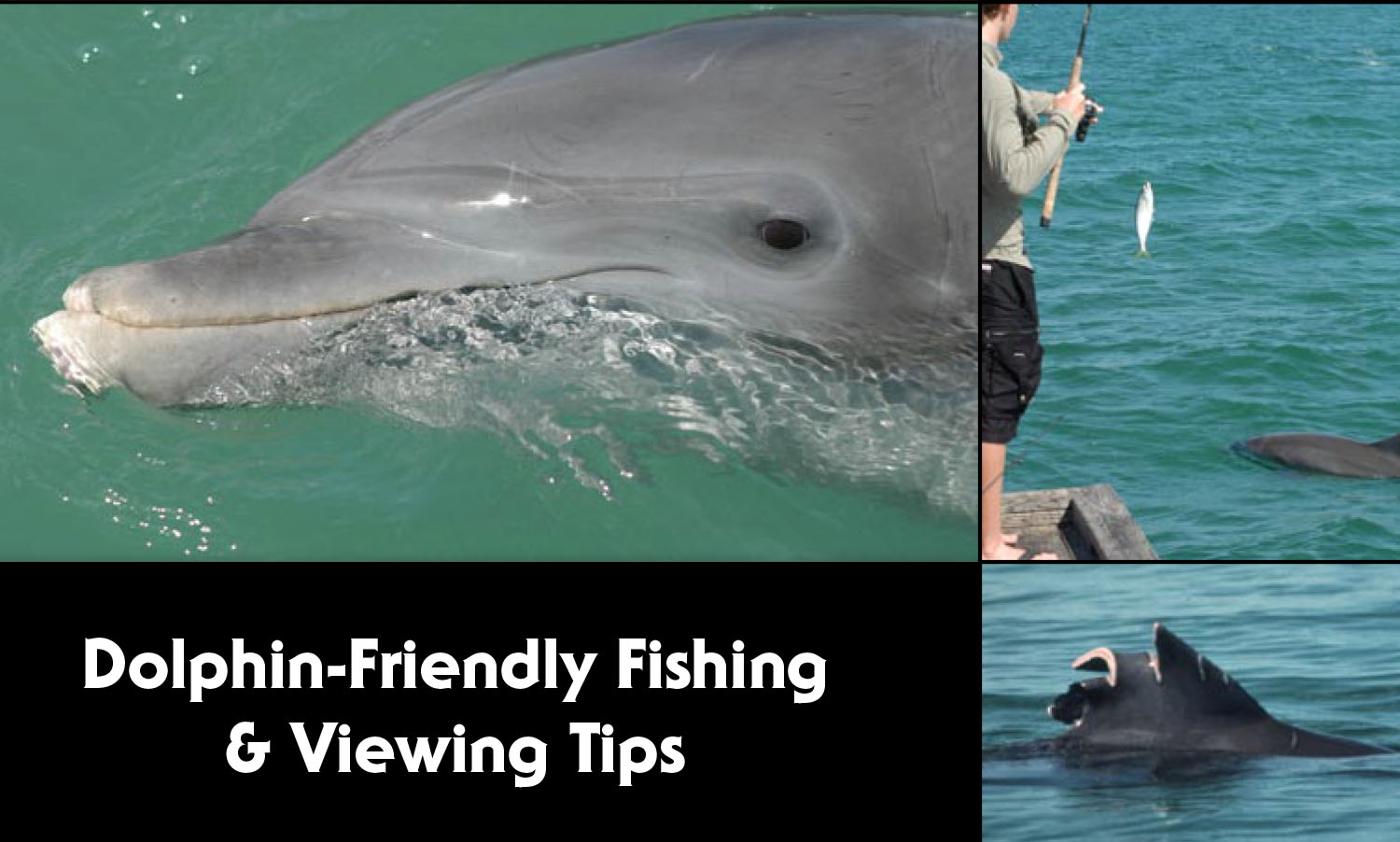 Feeding dolphins is illegal under the federal Marine Mammal Protection Act.
 - Reel in your fishing line if dolphins appear. Relax and enjoy the show until they depart.
- Change locations if dolphins show interest in bait or catch.
- Release catch quietly away from dolphins when and where it is possible to do so without violating any state or federal fishing regulations.
- Check gear and terminal tackle to make sure it won’t break off easily and, if your line does break, be sure to collect anything left behind in mangroves or on docks.
- Use circle and corrodible hooks and avoid braided fishing line.
- Stay at least 50 yards away from dolphins.
- Stash your trash in a lidded container on your boat until you can get to shore and dispose of it safely in a place where it will not blow back into the water. (An old tennis-ball can with a lid is perfect for stashing used line until you return to shore.)