
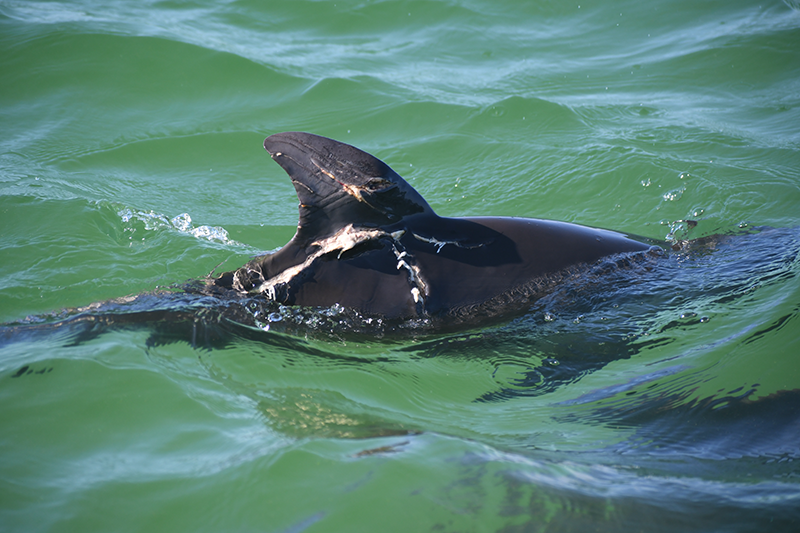
Dolphin 6741, the 2025 calf of 1674, is shown here with a fresh shark bite wound we observed in September 2025.
Did you know that in addition to studying dolphins, we also study sharks in collaboration with Mote Marine Laboratory’s Sharks and Rays Conservation Research Program? That’s because we need to understand dolphin prey and predators to gain a deeper understanding of the ecosystem dynamics that shape the dolphin community.
During our monthly photographic identification surveys of the dolphin community, we are able to document shark bite wounds on local dolphins, providing evidence of unsuccessful predation attempts (that is, attempts by sharks to eat the dolphins). These data are crucial for understanding seasonal and annual changes in predation pressure on the dolphin community.
Through our work, we know that bull sharks and tiger sharks are the most frequent predator of the dolphin residents. A New College of Florida graduate student used measurements of individual shark bite wounds to estimate the shark species and sizes responsible. Some larger wounds were consistent with bites from tiger sharks, while smaller wounds showed more overlap between species. Ongoing work will incorporate bite shape to further refine these estimates.
With our Mote collaborators, we have tagged bull sharks using acoustic transmitters to track shark movements and habitat use of Sarasota Bay (read more here). Through this partnership, we’ve tagged more than 50 bull sharks with transmitters that are expected to last seven to nine years. At least six of these sharks have been detected on receivers within Sarasota Bay and in the passes connecting the Bay to the Gulf. Most detections occurred at night between June and November — a period that also coincides with when fresh shark bite wounds are most frequently observed on resident dolphins. Some individual sharks have returned to the bay in multiple years, suggesting that the area may be an important seasonal habitat for at least some bull sharks.
In addition, we are also monitoring other shark species — including tiger, sandbar, and dusky sharks — to understand their seasonality and habitat use in the Sarasota area. When these animals leave Sarasota, we can track their wider movements throughout the Gulf and in the Atlantic Ocean via iTAG and FACT, two collaborative regional acoustic telemetry networks. .
Funding for this research has been provided by an anonymous donation to Brookfield Zoo Chicago and Mote Scientific Foundation. Special thanks to Jack Morris, Val Hagan, Dr. Bob Hueter, Dr. Demian Chapman, Capts. Dean Dougherty, Greg Byrd, Pete Hull and Cody Cole (Mote Marine Laboratory), as well as Dr. Jayne Gardiner and Tonya Wiley for their assistance with shark tagging and sampling.
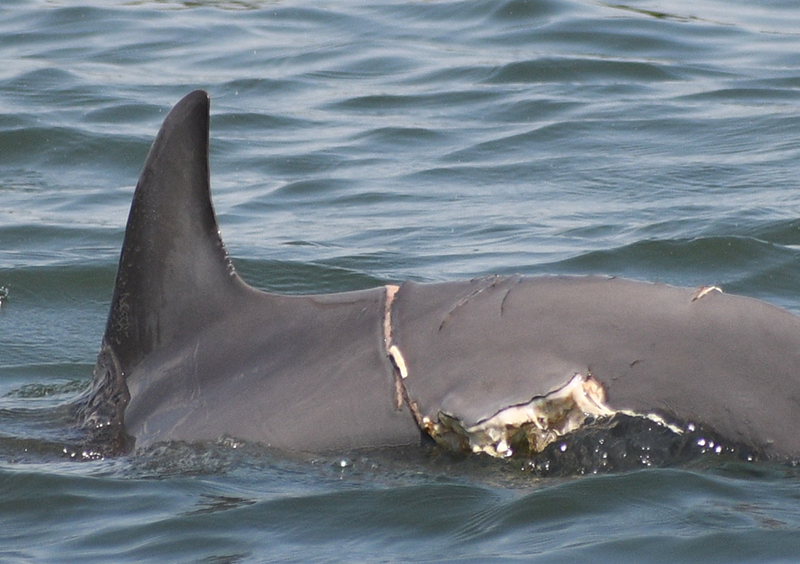
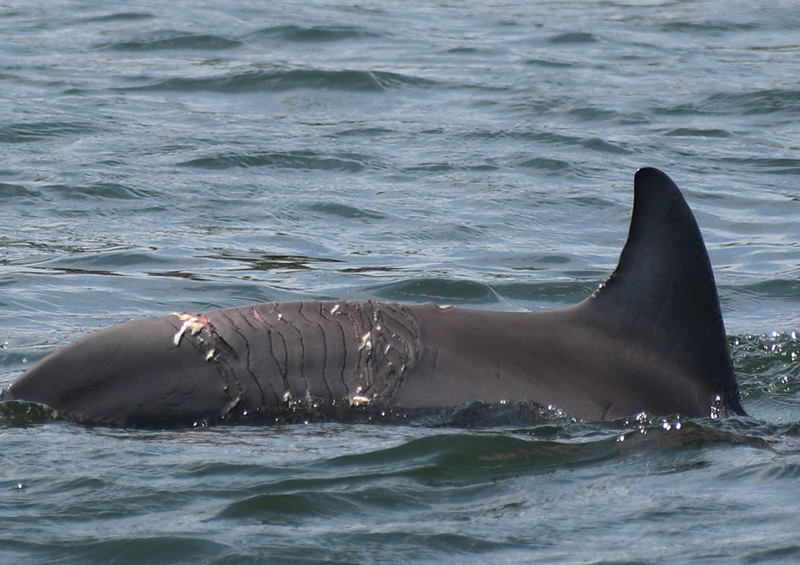
We took these pictures of Mid-Wicket (2094) in 2023. The images above illustrate just how different the same bite can be — and why it’s so difficult to determine the predator. One image shows Mid-Wicket’s left side and the other the right.
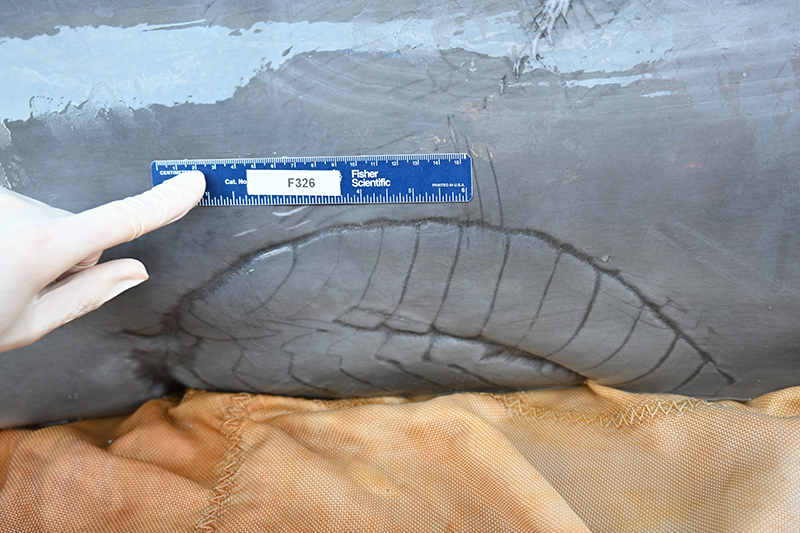
Squirt, pictured to the left, is one of our more well-known shark bite cases. This dolphin (F326) was born in 2019 and, during a health assessment in May 2023, we discovered a large healed shark bite wound on the underside of his body. During an ultrasound, we found that the wound actually rearranged his urinary tract. You can read more about that here and read the paper we published about his wound — “Case Report: Shark bite resulting in a urethral obstruction and urinary tract-body wall fistula in a bottlenose dolphin (Tursiops truncatus) in Sarasota Bay, Florida” — in the journal Frontiers in Veterinary Science here.