


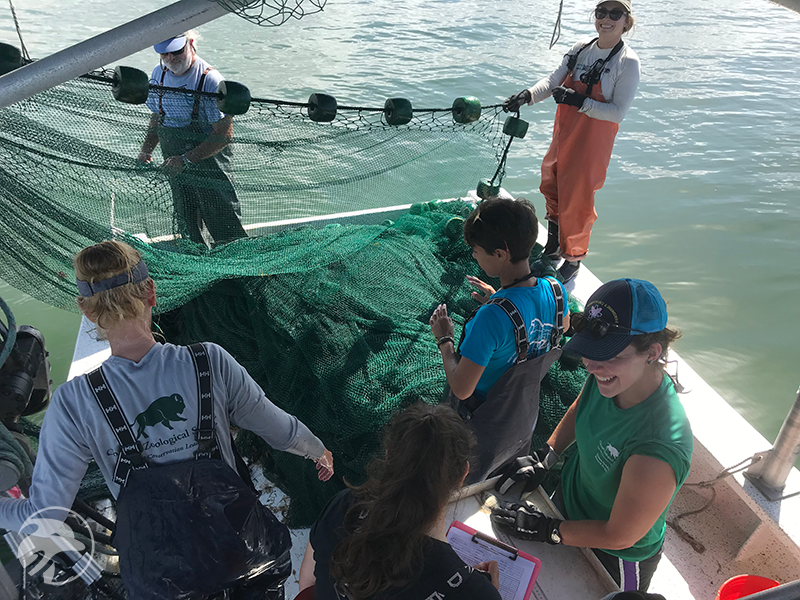
A team uses a seine net to capture fish in Sarasota Bay. The fish are released after they are catalogued as part of our prey fish studies, which began in 2004.
Notes from the Lab and Field: Prey Fish Surveys Help Us Understand Dolphins
Did you know that understanding dolphins and their behavior also means studying other species? In addition to studying the sharks of Sarasota Bay and their interactions with the dolphin community, we also conduct seasonal purse-seine catch-and-release  fish surveys that help us gain an understanding of the relative abundance of fish in Sarasota Bay and how that abundance impacts dolphins.
We’ve been conducting seasonal prey fish surveys across Sarasota Bay’s shallow seagrass meadows since 2004. In a study led by Elizabeth Berens McCabe, we conduct 10 seine-net sets per month during January-March and 10 per month during June-September. Fish are brought aboard, identified by species, measured and then released alive.
During our January surveys, initial catches indicate typical bay-wide abundances, with sets averaging 125.4 total fish and 95.2 dolphin-prey fish per set. Notably, January’s mean catch was the highest for any January in the past three years. Catches spanned a diverse range of species and sizes: of 1,254 fish examined, 75.9% were identified as dolphin prey, driven largely by high numbers of pinfish (906 individuals). Winter cold fronts and abundant drift algae may have influenced January’s totals.
February’s fish abundance increased by 54.7% month-over-month, with catches averaging 194.2 total fish per set and 160.2 dolphin-prey fish per set. This marks the second-highest February mean catch recorded over the past six years. Of the 1,942 fish captured during the month, 82.4% were identified as dolphin prey — driven largely by pinfish (1,441 individuals). Overall, catches included 33 species and a wide range of size classes. The next round of fish surveys is scheduled for March.
Now in its 23rd year, the dolphin prey fish survey program is supported by the Charles and Margery Barancik Foundation.
While conducting the prey surveys, we also gather environmental measurements, including water temperature, depth and salinity and dissolved oxygen, as well as a water sample to check for concentrations of Karenia brevis, the phytoplankton that causes Florida red tide. All of these environmental parameters can impact fish abundance, which in-turn impacts the dolphin community.
- You can read more about what happens when the prey community changes in this story.