

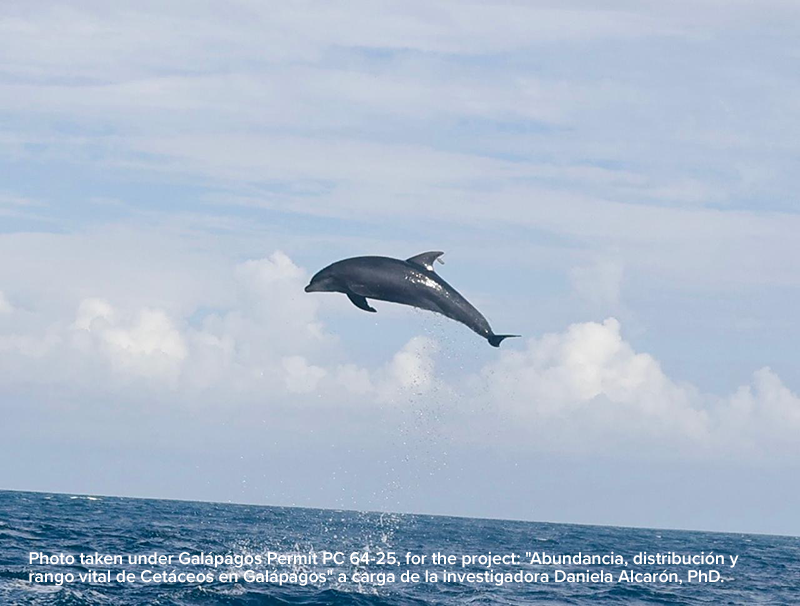
In April 2026, members of our team traveled to the Galápagos, a UNESCO World Heritage site. There, we (Aaron Barleycorn, field  manager and senior researcher, staff scientist Dr. Krystan Wilkinson, and I) worked with the Cetacea Galapagos Program from the Galapagos Science Center (GSC) to attach satellite-linked tags to bottlenose dolphins using the TADpole — the pole-mounted Tag Attachment Device that we developed in partnership with Woods Hole Oceanographic Institution. This marks the first time satellite telemetry has been used with bottlenose dolphins in the islands, and the first time we’ve used the TADpole outside of the U.S. In all, we were able to tag four dolphins off Puerto Baquerizo Moreno, Isla de San Cristóbal, two of which are transmitting on a regular basis. The tag on Dolphin ID 47515, deployed on March 11 and pictured below, provides information on locations, dive depths, and dive duration. The tag on Dolphin ID 47582, deployed on March 12, provides location data only.
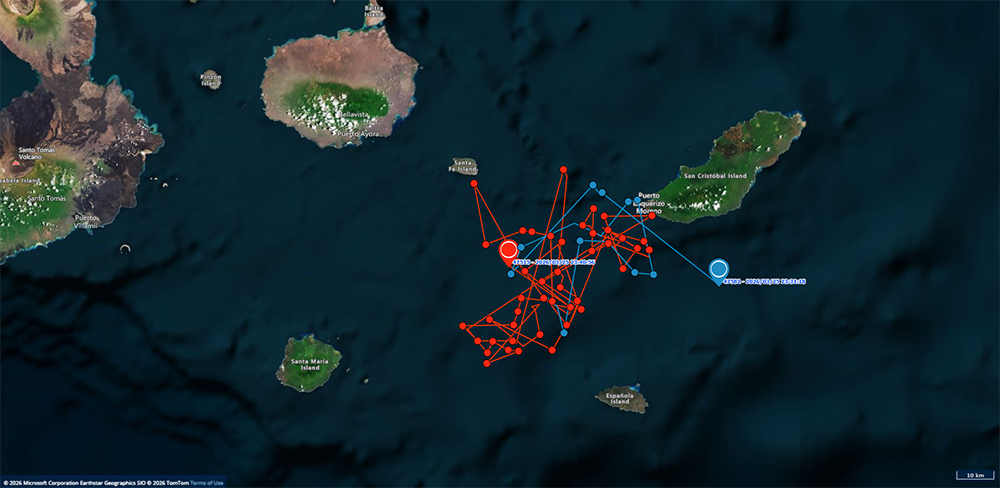
To date, the dolphins have remained in the region between Isla de San Cristóbal and neighboring islands of Isla Santa Fé and Isla Española. They frequent waters near seamounts and ridges. Dolphin ID 47515 has made dives to as deep as 512 m — that’s more than 1,600 feet — much deeper and longer than what we have documented for bottlenose dolphins recently over the West Florida Shelf, but not as deep or long as for bottlenose dolphins we tagged several years ago off Bermuda. The map above shows the cumulative movements of dolphins 47515 and 47582 through March 25, 2026.
Dolphin 47515 with its new satellite-linked tag on its dorsal fin.
This research is conducted under the Whales and Dolphins CETACEA–Galápagos Research Program, led by Universidad San Francisco de Quito (USFQ) Research Scientists and Professors Dr. Daniela Alarcón, and Dr. Juan Pablo Muñoz-Pérez. The project is authorized by the Galápagos National Park Directorate under Research Permit PC 64‑25, titled “Abundancia, distribución y rango vital de cetáceos en Galápagos,” and is carried out under the scientific responsibility of Principal Investigator Dr. Daniela Alarcón. Primary support for this project is from the Mote Scientific Foundation, with an additional two tags provided by Fundación Oceanogràfic de la Comunitat Valenciana and some of the vessel time provided by Greg Lewbart’s and Diane Deresienski’s IslaVet 2026 class.
While my focus was on dolphins, another team from the Galapagos Science Center that included Research Associate Kim Bassos Hull, and later, Krystan, was sampling and tagging sharks and rays — particularly manta rays (like the one Kim is photographing above).
Notably, they also observed a juvenile female whale shark in a location they are not known to frequent and seven of the eagle rays tagged were recaptures from both within the season and from previous years — a record!
It is truly exciting to be able to be involved in new biological discoveries in an area where discoveries by Charles Darwin established the basis for important biological theories.
— Randy Wells