


Inviting Scientific Collaborations on the TADpole — the Pole-Mounted Tag Attachment Device
Are you interested in collaborating with the Sarasota Dolphin Research Program on using the TADpole to tag dolphins at your study site?
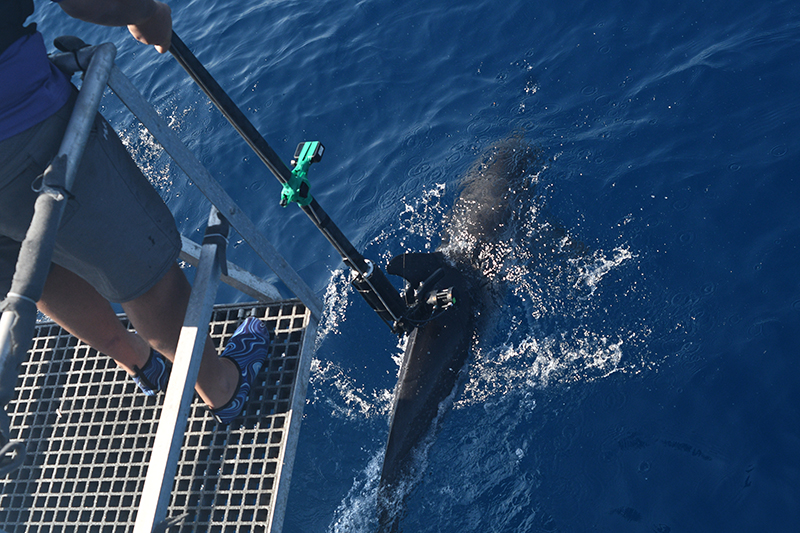
Using the TADpole to attach a Wildlife Computers SPLASH10-397A satellite-linked tag to an Atlantic spotted dolphin over the West Florida Shelf, April 2024. Photo ©Sarasota Dolphin Research Program | Photo taken under NMFS/MMPA Scientific Research Permit No. 26622.
As of October 2026, our pole-mounted Tag Attachment Device (affectionately known as the TADpole) has been used successfully to tag 32 bow-riding dolphins of four species with satellite-linked transmitters (eight Atlantic spotted dolphins off Florida’s west coast, 17 Hawaiian spinner dolphins, and five bottlenose dolphins in Hawai’i and the Galápagos, and two pantropical spotted dolphins in Hawai’i). The tool is at the point of development where we are ready to develop collaborations with others to apply it to their research situations, under specific circumstances.
The SDRP has engaged in tagging dolphins with satellite-linked transmitters since 1990, and has been involved in preparation, deployment and/or tracking of more than 250 such tags. Previously, attachments of satellite-linked tags by SDRP or others had required catch-and-release, or use of a rifle or crossbow to attach a projectile tag via embedding darts. We wanted an alternative to the existing approaches, so in 2014 we began working with Woods Hole Oceanographic Institution (WHOI) veterinarian Michael Moore and WHOI engineer Tom Lanagan to develop a new approach.
The prototype design developed by WHOI uses pneumatic pressure to secure a tag to the trailing edge of the dorsal fin of a bow-riding dolphin with a single pin, in just a fraction of a second (see photo, and video). The development process was iterative. Designs were first tested in the lab on dorsal fins from dead stranded animals. After tweaking, field testing was done in Florida and Hawai’i, followed by more tweaking and lab tests, and then more field tests of the tagging system and attachments in Florida. The primary issue we encountered was the great speed with which dolphins can move out of the device when they feel its touch, before the device could trigger and attach a tag. This rapid response time is great for thwarting toothy grabs by potential predators, but not so good for potential taggers. Further modifications reduced the tagging time by crucial milliseconds. Parallel tests of attachment pins were performed with bottlenose dolphins in Sarasota Bay to better understand the duration of attachment and ultimate tag shedding. A description of the tool and its development was published in 2024, and a copy of the paper can be found here.
Tags have remained attached to dolphins for up to: 89 days for the Atlantic spotted dolphins, 72 days for pantropical spotted dolphins, 35 days for bottlenose dolphins, and 60 days for spinner dolphins. The median attachment durations were much longer than those for tagging small cetaceans via an alternative remote tagging deployment system, dart-attached projectile LIMPET tags, as deployed by Cascadia Research Collective, our collaborators in Hawai’i. Attachment durations remain shorter than those for hand-mounted tags, and appear to be related to location of tag placement on the fin, which is very challenging given the different simultaneous 3-D movements of the dolphin, boat, and tagger.
Deployments to date have demonstrated the utility of this tagging tool to the point of planning for use with further field projects, but with a number of caveats. We are still learning the limitations of the tool with each attempted deployment, and identifying refinements needed. It is not, and will likely never be, a dolphin tagging tool that will be applicable for every foreseeable situation. However, every dolphin that can be successfully tagged with this tool is one less dolphin that might not otherwise have been tagged, or might have been tagged with a more invasive and less effective (in terms of attachment duration) approach, such as projectile tags with multiple penetrating darts.
Among the conditions leading to successful tag deployments to date are:
- Tagger experience,
- Calm conditions,
- Slow-moving dolphins,
- Proper positioning for surfacings at the bow of the boat (distance and angle); this is likely vessel- and species-dependent,
- Surfacing within 2m of the bow.
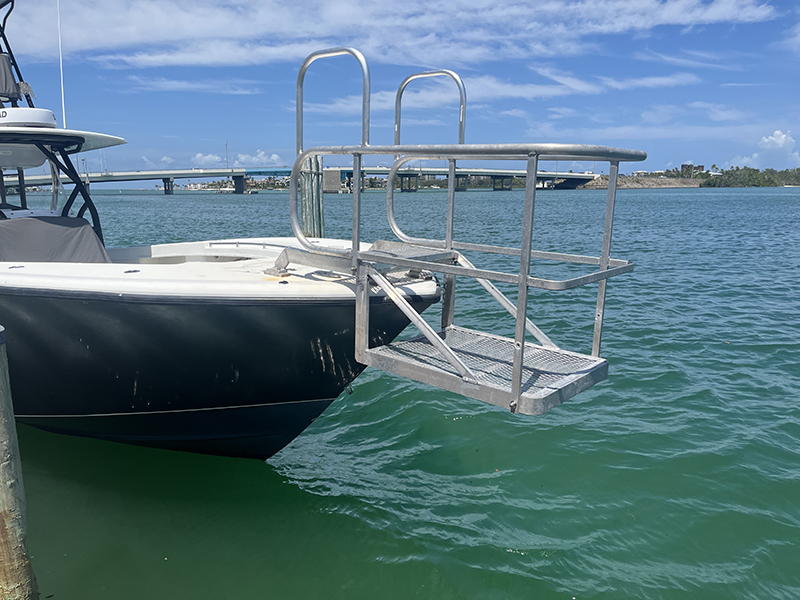
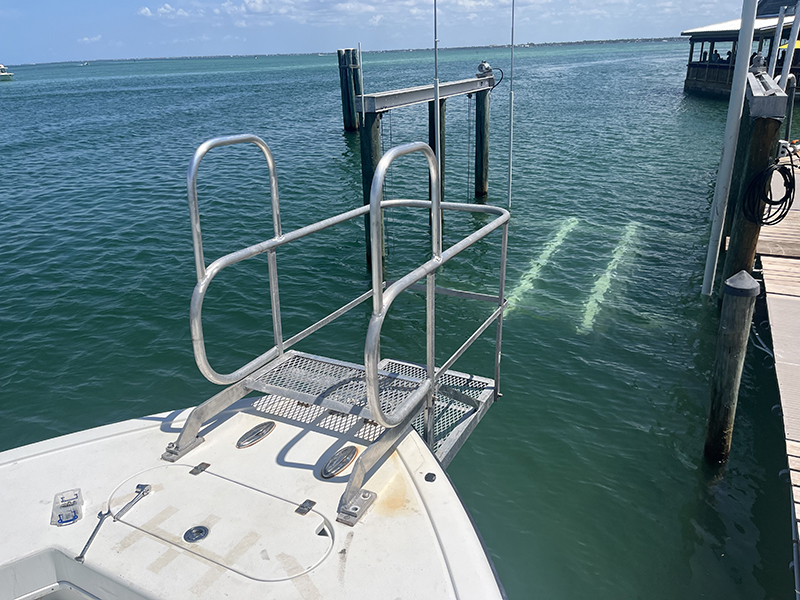
To date, we have tagged four species but believe it can be used with other species of small dolphins. As the dolphins get bigger, their dorsal fin thickness at a distance of 35 mm cranial from the trailing edge of the dorsal becomes too thick for the tool to penetrate. Where dolphins ride and surface will depend on the bow wave pushed by the vessel — different vessels will have different bow wave characteristics. We have successfully tagged from bow pulpits on four different vessels, and from the open bow of a panga — pulpits are definitely preferred and increase the probability of success (see photos below). We want to expand our ability to use the tool from a variety of vessels and with different species.
Anyone who would be interested in collaborating with application of the TADpole at their research site should provide us with:
- Photos of the proposed tagging vessel, with photos clearly showing the configuration of the bow as it would affect the TADpoler’s safety, stability, and access to the dolphins,
- Video of the dolphins riding at the bow,
- Data on the thickness of the dolphins’ dorsal fin at a distance of 35 mm cranial to the trailing edge, if available,
- Confirmation that appropriate research permits are in place or imminent.
With this information we can begin to assess feasibility.
If we consider the project to be feasible and safe, then a next step would likely involve arranging to bring one of our staff members to your field site with the TADpole, to initiate tagging and potentially train local staff in its use. Please contact Aaron Barleycorn at Barleycorn@Mote.org if you are interested in using the TADpole at your research site.
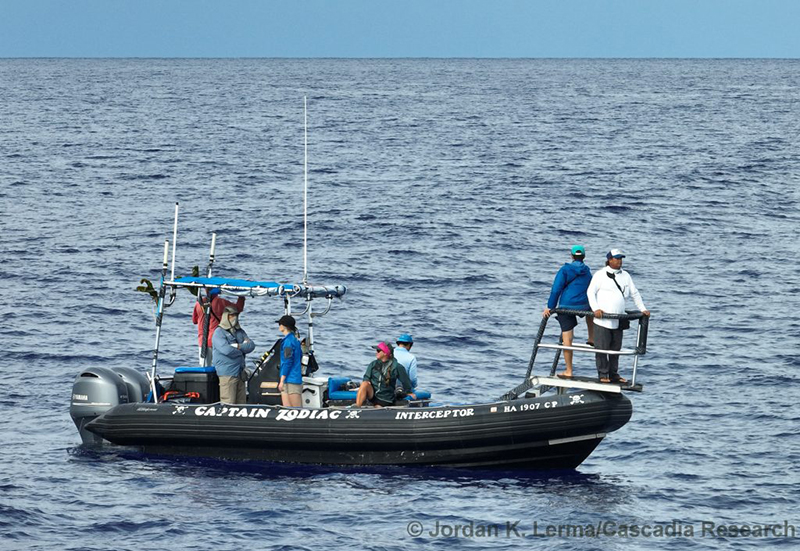
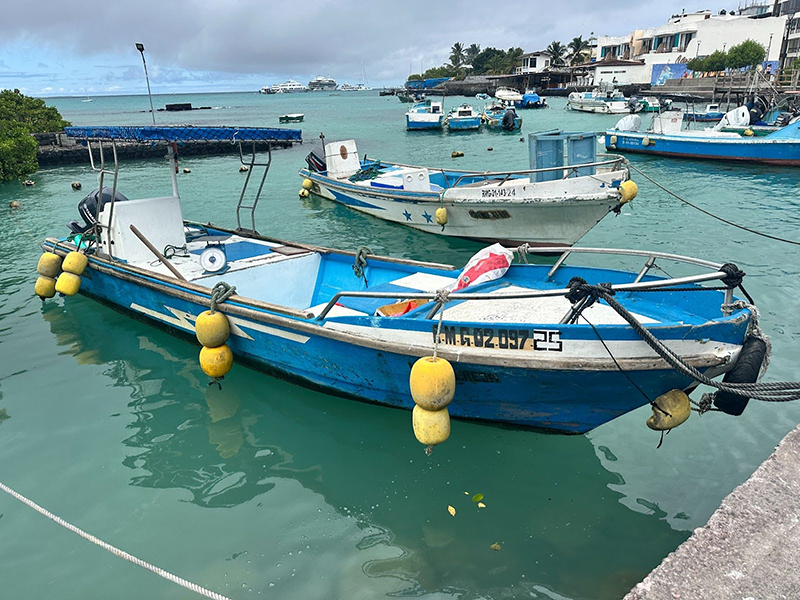
The images below show examples of boats that have been used to successfully tag dolphins with a TADpole. The tagger needs to be able to orient the tool vertically off the bow in order to tag. A pulpit extending past the boat’s bow is ideal, although we have been successful kneeling at the bow of a panga (image bottom right).
Read more about how we’ve used the TADpole
Tagging Dolphins in the Galápagos
In April 2026, members of our team traveled to the Galápagos, a UNESCO World Heritage site. There, we (Aaron Barleycorn, field manager and senior researcher, staff scientist Dr. Krystan Wilkinson, and I) worked with

Atlantic Spotted Dolphins Tagged in September 2025
Notes from the Lab and Field In September, we were once again over the West Florida Shelf tagging dolphins. This one, an Atlantic spotted dolphin nicknamed “Patty,” was seen the next day with
Spinner Dolphin Studies
TADpole Breaks New Ground in Spinner Dolphin Studies During field work in O'ahu, Hawaii in earlier this summer (2025), SDRP collaborated with Robin Baird of Cascadia Research Collective to deploy satellite-linked tags
TADpoles and Dolphins
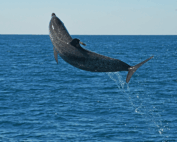
What do TADpoles have to do with dolphins? Development of a remote Tag Attachment Device The Sarasota Dolphin Research Program has acted as a testbed for the development of many
Two Offshore Dolphins Tagged
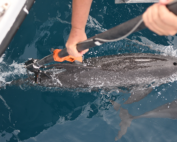
Dolphins Tagged Off the West Florida Shelf We were able to sneak in a day of offshore field work between fronts the week of Dec. 18, 2024. We tagged two Atlantic spotted
Offshore Research Update
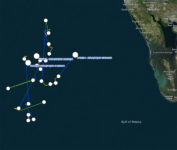
June 2024 Offshore Dolphin Research Update Since 2022, we’ve been conducting health assessments of offshore dolphins to gather data needed to address critical information gaps for the little-known species that regularly inhabit west
Notes from the Lab and Field
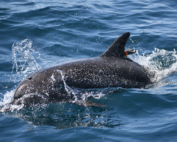
This Atlantic spotted dolphin nicknamed Hannah was tagged 45 miles offshore of Sarasota using a new tool we developed. New Tagging Technique Developed in Sarasota Could Impact Dolphins Worldwide If you’ve