
Notes from the Lab and Field
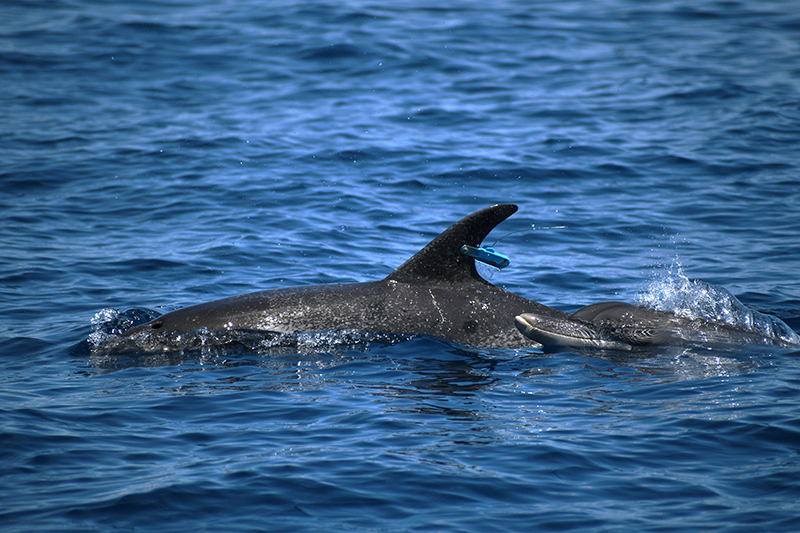
In September, we were once again over the West Florida Shelf tagging dolphins. This one, an Atlantic spotted dolphin nicknamed “Patty,” was seen the next day with a somewhat smaller dolphin that was acting like it might be her calf.
In May 2022, we initiated studies of dolphins inhabiting the waters over the West Florida Shelf, offshore of Sarasota. With support from the Florida RESTORE Act Centers of Excellence grant program, our team hoop-netted bow-riding dolphins of three species. The animals were brought aboard a floating mat or onto the afterdeck and we performed veterinary examinations and sampling, and tagged them with satellite-linked transmitters to provide location and dive data, as well as short-term digital archival tags that would provide more detailed behavioral and acoustic data, and then released them.
In September 2025, we again worked offshore, building on our previous work. Our goals were to:
- Increase our sample sizes for health and movement data of dolphins over the West Florida Shelf;
- Test a novel suction-cup-mounted camera tag developed by Dr. Jeremy Kiszka, Associate Professor at Florida International University (FIU);
- Try a new hoop-netting capture approach.
With support from Mote Scientific Foundation and FIU/Fahlo, we conducted an offshore tagging and health assessment project, experimenting with techniques to streamline our operations and reduce expenses. We used a smaller, faster, less expensive boat and a smaller team and focused on shorter handling and quick tagging instead of the more extensive health assessments. Fortunately, we had near-perfect conditions offshore, and the new approach worked well with Atlantic spotted dolphins (we had previously successfully used our TADpole to tag dolphins from this boat).
After examining the dolphins, we tagged them with satellite-linked transmitters. We also deployed FIU’s camera tags on two of the dolphins and successfully tracked and recovered the small floating tags the following day more than 50 miles from our dock. Both tags successfully recorded video and behavioral data (still being processed). This was the first time these cameras have been used on dolphins. (Click here to read more about some of the tools and techniques we’ve developed and/or tested over the years in dolphin studies.)
To date, we’ve now successfully caught, sampled and tagged 15 dolphins over the West Florida Shelf using hoop nets and have used the TADpole to tag another eight dolphins.

Atlantic spotted dolphin nicknamed “Buddy” wearing an orange camera tag as well as a Finmount satellite-linked tag. The camera tag developed by FIU automatically released from the dolphin and was retrieved the next day.
The September Dolphins and Their Travels
The map below shows the locations for dolphins tagged by the Sarasota Dolphin Research Program with satellite-linked transmitters through Oct. 10, 2025, during tagging, health assessment, and FIU camera tag deployments over the West Florida Shelf offshore of Sarasota, Florida. The largest dot at one end of each animal’s line is the most recent location along with its tag ID; only the highest-quality locations are shown. From north to south, the dolphins are Patty, Denise and Buddy.
- ID PTT 286483 (SfG018, Buddy) — Atlantic spotted dolphin, Stenella frontalis, 186 cm male, tagged on 24Sep25, 77 km off North Captiva Island, in waters 35 m deep. This dolphin was named in honor of Dr. Buddy Powell, an amazing conservationist and manatee researcher, whom we lost this summer.
- PTT 286485 (SfG011, Denise) — Atlantic spotted dolphin, Stenella frontalis, 205 cm female, tagged on 24Sep25, 81 km off Captiva Island, in waters 37 m deep. This dolphin was named in honor of Dr. Denise Herzing, the pioneering Atlantic spotted dolphin researcher who also provides us with age estimates for our tagged dolphins.
- PTT 286481 (SfG013, Patty) — Atlantic spotted dolphin, Stenella frontalis, 201 cm female, tagged on 25Sep25, 65 km off Casey Key, in waters 35 m deep. This dolphin was named in honor of recently retired NMFS geneticist Dr. Patty Rosel, who did much to define stocks of dolphins and other cetaceans in the Gulf of Mexico and Atlantic Ocean.